
AISB Convention 2025 – Call for Symposia Proposals

AISB Convention 2025 – CALL FOR SYMPOSIA PROPOSALS

priority deadline: 2 August 2024
regular deadline: 30 August 2024

14-16 January 2025, University of the West of England UWE, Bristol, UK
https://aisb.org.uk/aisb-convention-2025-non-members/

The society for the study of Artificial Intelligence and the Simulation of Behaviour (the AISB) annual convention will be held at UWE Bristol, UK on 14-16 January 2025. The convention will follow the same overall structure as previous conventions, namely a set of co-located, parallel symposia, as well as invited and plenary lectures and sessions. We are currently seeking proposals for these symposia. Typical symposia last for one or two days, and can include any type of event of academic benefit: talks, posters, panels, discussions, demonstrations, outreach sessions, etc. Proposals to run symposia are welcomed across all areas of Artificial Intelligence and the Simulation of Behaviour, broadly understood. This includes interdisciplinary topics rooted in the social sciences, arts, and humanities.

Possible themes are listed below (not an exhaustive list):

  • Knowledge Representation
  • Discourse and Dialogue
  • Natural Language Processing
  • Computational Intelligence
  • Computational Theory of Mind
  • Philosophical Foundations of Artificial Intelligence
  • Consciousness and Machine Consciousness
  • Human and Machine Creativity
  • Simulation of Human and Animal Behaviour
  • Neural Networks and Machine Learning
  • Computational Neuroscience
  • Robotics and Robot Ethics
  • Epigenetic and Developmental Robotics
  • Autonomous Agents and Agent Based Computing
  • Enactivism
  • Embodied Cognition
  • Ecological Cognition
  • Embedded [Social] Cognition
  • Extended Cognition
  • Affective Intelligence and Behaviour
  • Embodied Audio-Visual Interaction
  • Style in Text; Textual Forensics
  • Robotics, Perception and Art
  • Live Algorithms
  • Cultural, Social and Media Theory and Computing
  • Sensorimotor Theory
  • Cybernetics and Human Knowing
  • Sensory Substitution
  • Distributed Thinking
  • Robot Language and Communication
  • Proposing a Symposium

Symposia Organisation

Each symposium is organised by its own organising committee. The committee proposes the symposium, defines the area(s) and structure for it, issues calls for abstracts/papers etc., manages the process of selecting submitted papers for inclusion, and compiles an electronic file for inclusion in the convention proceedings. Organisers are welcome and encouraged to invite keynote speakers to their symposia, but they are also encouraged to seek external funding in order to pay keynote speakers’ registration fees and other costs. Symposium organisers and all speakers will be expected to pay registration fees.
Proposers are welcome to submit, or be involved with more than one proposal.
Proposers need not already be members of the AISB (though you will be expected to join the AISB if your symposium proposal is accepted).

Symposium proposals will be handled in two phases: For early approval, apply by the priority deadline. This will ensure the symposium is hosted at AISB 2025 if it meets the basic criteria. Proposals received after the priority deadline but before the standard deadline will undergo the same process, but acceptance is subject to conference venue logistics, such as room availability.

Priority deadline for symposium proposals: 2 August 2024
Notification of acceptance (first round): 9 August 2024
Standard deadline for symposium proposals: 30 August 2024
Notification of acceptance (second round): 6 September 2024

Submissions should consist of the following:

  • A title
  • A 300-1000 word description of the scope of the symposium, and its relevance to the convention along with the nature of the academic events (talks, posters, panels, demonstrations, etc.)
  • Whether the symposium is intended as a sequel to a symposium at a previous AISB conference.
  • An indication of whether submissions will be by abstract, extended abstract or full paper.
  • Your preferences about the intended length of the symposium as a number of days (preferably one or two days, but anything from half a day to three days), together with a brief justification.
  • A description (up to 500 words) of any experience you have in organisation of academic research meetings (please note that it is not a requirement that you have such experience).
  • Names and affiliations of any invited speakers that you may have in mind for the symposium.
  • Your names and full contact details, together with, if possible, names and workplaces of the members of a preliminary, partial programme committee.

Please email your completed proposal to symposia-proposals@aisb.org.uk

Venue

The University of the West of England (UWE Bristol) is thrilled to welcome you to our vibrant and dynamic campus, known for its cutting-edge facilities and strong connections with industry. We hope you enjoy your stay and take advantage of all that UWE Bristol and the beautiful city of Bristol have to offer. UWE Bristol’s main campus is located 2 miles from the M4 and M5 motorways and has good links with Bristol Parkway train station and city centre buses.
Next Spotlight Seminar on AI – 20 June 2024

The Italian Association for Artificial Intelligence, in collaboration with the AISB (Society for the Study of Artificial Intelligence and Simulation of Behaviour, UK) is pleased to announce the next seminar of its Spotlight Seminars on AI initiative:

30 June – 4:00PM (BST)
Title: Symbolic Reasoning for Large Language Models
Speaker: Guy Van den Broeck, UCLA, USA

Link Streaming (Live section): https://www.youtube.com/c/AixiaIt

Many expect that AI will solve society’s problems by simply being more intelligent than we are. Implicit in this bullish perspective is the assumption that AI will naturally learn to reason from data: that it can form trains of thought that “make sense”, similar to how a human expert might reason about a case, or more formally, how a mathematician might prove a theorem. This talk will investigate the question whether this behavior can be learned from data, and how we can design the next generation of AI techniques that can achieve such capabilities. It will focus on neurosymbolic reasoning for large language models, both at training and generation time, using probabilistic circuits as the architecture that bridges learning and reasoning.
Bio: Guy Van den Broeck is an Associate Professor and Samueli Fellow at UCLA, in the Computer Science Department, where he directs the StarAI lab. His research interests are in Machine Learning, Knowledge Representation and Reasoning, and Artificial Intelligence in general. His papers have been recognized with awards from key conferences such as AAAI, UAI, KR, and OOPSLA. Guy is the recipient of an NSF CAREER award, a Sloan Fellowship, and the IJCAI-19 Computers and Thought Award.

The joint AI*IA/AISB Committee of the Spotlight Seminars on AI,

Giuseppe De Giacomo
Floriana Grasso
Antonio Lieto
Bertie Muller
Luciano Serafini

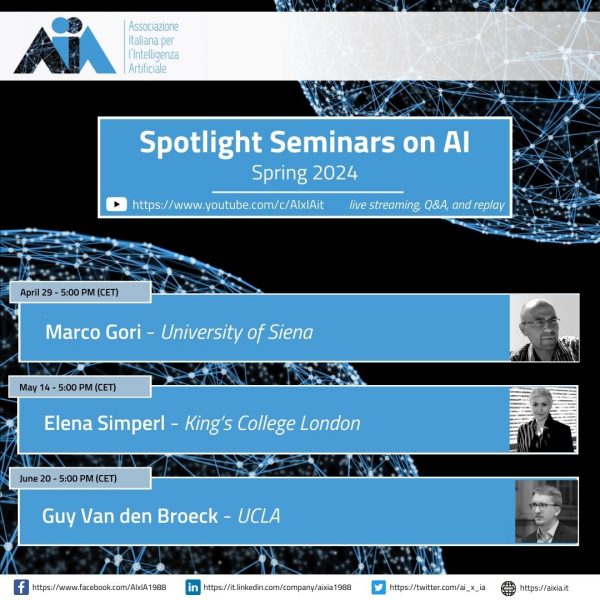
Spotlight Seminars on AI – Spring 2024 Program

The Italian Association for Artificial Intelligence (AI*IA), in collaboration with AISB (Society for the Study of Artificial Intelligence and Simulation of Behaviour, UK), is pleased to announce the Spring 2024 program of the Spotlight Seminars on AI.

Spotlight Seminars Autumn 2024 Programme

The aim of the seminars is to illustrate, explore and discuss current scientific challenges, trends, and possibilities in all branches of our articulated research field. The seminars will be held virtually on YouTube, on a monthly basis, by leading Italian researchers as well as by top international scientists.

The seminars are mainly aimed at a broad audience interested in AI research, and they are also included in the Italian PhD programme in Artificial Intelligence; indeed, AI*IA warmly encourages the attendance of young scientists and PhD students.

The “Spring 2024” edition features 3 seminars:

April, 29 – 5:00PM (CET)
Title: Consciousness and Laws of Learning
Speaker: MARCO GORI, University of Siena
Watch Online: https://www.youtube.com/watch?v=ti0uPvIwyDM

May, 14 – 5:00PM (CET)
Title: Fostering Responsible AI with MLCommons
Speaker: ELENA SIMPERL, King’s College London

June, 20 – 5:00PM (CET)
Title: TBA
Speaker: GUY VAN DEN BROECK, UCLA

The joint AI*IA/AISB Committee of the Spotlight Seminars on AI:
Giuseppe De Giacomo
Floriana Grasso
Antonio Lieto
Bertie Muller
Luciano Serafini

AISB 2023

When: 13-14 April 2023

Where: Swansea, Wales, UK

The AISB Convention is a flourishing annual conference that thrives from an interdisciplinary audience and facilitates discourse amongst a diverse set of researchers and research cultures. Attendance will be free for AISB members.

The 2023 convention of the Society for the Study of Artificial Intelligence and Simulation of Behaviour (AISB) will be held as a hybrid in-person and online event 13-14 April 2023. The convention will consist of several tracks based on popular symposia of previous AISB conventions instead of separately organised symposia. This decision was made to streamline the processes involved in organising the convention in the context of reduced timeframes due to COVID-19 disruptions from the past years and the longer-term changes this has brought about for the reseach community. In addition to the thematic tracks, we will run a general track that can accommodate papers on any topic related to AI.

Please see below for a list of tracks for 2023.

AI & Games (AIG)

This track focuses on the application of artificial intelligence or intelligent-like techniques, frameworks and theories to the creation of intelligent games.
AI can be used in any manner suitable in the game, from the algorithm to making the game more engaging, personalised, and/or interactive.
The following non-exhaustive list of research and practice shows potential submission topics:

  • Use of AI techniques (e.g. planning, learning, evolution etc.)
  • Design and engineering of AI components
  • Procedural content generation
  • Intelligent or adaptive player interaction
  • Game analytics
  • Data-driven player modelling
  • Agent decision making systems
  • Intelligent agents
  • Environmental simulations
  • Interactive narrative generation
  • Intelligent narrative technologies
  • Experimental AI
  • Serious games & gamification

AI Ethics (AIE)

Recent years have seen an increased awareness of ethical issues stemming from a lack of responsibility in the design and deployment of AI- and data-driven technology systems. This track explores solutions to these issues. Some topics of interest:

  • Algorithmic fairness
  • Diversity
  • Data governance
  • Accountability
  • Data privacy
  • AI ethics principles
  • Implementing ethical reasoning
  • AI regulation
  • Explainable AI

Computational Creativity (CC)

Computational creativity is continuing to attract researchers from both arts and science backgrounds. Philosophers, cognitive psychologists, computer scientists and artists have all contributed to and enriched the literature.
Many argue a machine is creative if it simulates or replicates human creativity (e.g. evaluation of AI systems via a Turing-style test), while others have conceived of computational creativity as an inherently different discipline, where computer generated (art)work should not be judged on the same terms, i.e. being necessarily producible by a human artist, or having similar attributes, etc.
More general topics of interest for this symposium include, but are not limited to:

  • Novel systems and theories in computational creativity, in any domain, e.g. drawing and painting, music, storytelling, poetry, conversation, games, etc.
  • The evaluation of computational creative systems, processes and artefacts
  • Theory of computational aesthetics
  • Representational issues in creativity, including visual and perceptual representations
  • Social aspects of computational creativity, and intellectual property issues
  • Creative autonomy and constraint
  • Computational appreciation of artefacts, including human artwork

Philosophy & AI (AIP)

With its origins in the Philosophy after AI symposium from previous AISB Conventions, this track sets out to investigate the philosophical and linguistic perspectives of the research paths which deal with language as it is conceived by AI. Contributions to a general philosophical discourse on AI are also welcome.
We invite talks on the following (but not exclusively) topics:

  • Linguistics and AI;
  • AI research on language;
  • Learning, creativity and AI;
  • Meaning and AI;
  • Creativity, machine-learning and language;
  • Robots and communication;
  • Truth, post-truth and AI;
  • Social media, devices and human sociality.

General Track (GT)

This track accommodates AI research that does not align with any of the other special tracks. Possible topics include:

  • Agents and multi-agent systems
  • Agent-based social simulation
  • Verification of AI systems
  • Combining learning and reasoning
  • Argumentation
  • AI & cyber security
  • Natural language processing
  • Knowledge representation

Submission

Submissions to any of the tracks are in the form of extended abstracts and are subject to peer review. Proceedings will then accommodate final papers as short or regular papers. These are limited to the following page restrictions.

  • Extended abstract (max. 2 pages)
  • Short paper (max. 4 pages)
  • Regular paper (max. 8 pages )

Web site and submission links will be available from mid-January 2023.

Important Dates

  • Submission: 6 March 2023
  • Notification of acceptance: 27 March 2023
  • Camera-ready paper: 3 April 2023

Program Committee

General Chair: Bertie Müller (Swansea University)

Track Chairs: TBA

  • Track AIG:
  • Track AIE:
  • Track CC:
  • Track AIP:
  • Track GT: